A blog for fans of Bananagrams, word games, puzzles, and amazing things
Showing posts with label wordsquared. Show all posts

Wednesday, June 8, 2011

Review of the new version of WordSquared

The brand new version of Word2 is now out. It comes with a different design (lots of wood grain and most squares on the board are off-white) and a host of different rules which definitely change the game.
One of the problems with the original version of WordSquared is that once you developed a big enough word structure, you could always find a place to put almost any letter. Consequently I quickly stopped needing the "Swap Tiles" option, and so accumulating lives (by building on the stars dispersed around the board) became irrelevant.

The new version solves this by no longer giving you blanks for free. You start off with three, and then if you want more, you have to buy them. (Five stars buy one blank tile, and swapping your seven tiles for a new rack now costs twenty stars.) Word formation is consequently more challenging. Your rack now consists of seven non-blank tiles and one slot for an arbitrary number of blanks.

Stars are acquired in a variety of ways. Stars are granted for logging in once a day and for achieving certain score benchmarks (called "Levels"). Stars may also be acquired by building a word over a square with a star on it. While you will often get just 1 star for building over a Star Square, occasionally you will get more. I've gotten 2 stars in a couple of instances and 3 stars once. (When beta-testing, I once got 8 stars.) Since the number of stars dispensed is random, this is an example of operant conditioning: varying the reward (as when training an animal) results in more rapid acquisition of the skill being trained for. In Word2, randomizing the reward should make you crave the stars more...

A new feature called "teleporting" is supposed to solve the problem of players being boxed in. On the one hand, it takes away the perpetual threat that you are going to be trapped somewhere if you don't check in with the game frequently enough. But on the other hand, such fear is really not a good way to motivate players. We ought to play games because they are fun, not to prevent others from building impenetrable double-walled word structures around us.

The new version also alters the tile values and tile distribution from the Scrabble parameters, based upon how Word2 players have played in the past.
The vowels are all still worth 1 point, except for the U which is two (logically, as the U is the hardest vowel to use). A Y is worth 5 points.

This table compares Scrabble tile values with those for WordSquared:

ABCDEFGHIJKLMNOPQRSTUVWXYZ
Scrabble1332142418513113101111448410
Word21543154419624214102112558510

There are a number of interface changes:
  • When you play a blank, instead of having to type in the letter you want to play, you are presented with a complete alphabet of tiles from which you may choose by clicking.
  • Placemarks are placed, not by double-clicking, but by dragging a placemark icon from the bottom of the placemark list.
  • For now at least, your word history is hidden in your profile, which you can get to by clicking on your avatar icon.
The best change is the new transition between the full map and the mini-map which is now a smooth animation, making it easier to maintain a sense of where you are in the WordSquared world.

This new version of Word2 breaks with the Scrabble rules and model in favor of making Word2 a better massively multiplayer game. The creators seem full of ideas, and I am interested to see what they do next.


Further clicking:

Wednesday, April 20, 2011

Innergrams and what they can tell us about word favoritism

So I was playing Word2, and I had a rack of A R T T U _ _ and a desire to build down from the word LEND. Reflexively, I spelled DART and was about to move on when I paused and asked myself "Why didn't I make DRAT?". DRAT is a perfectly fine word, and unlike DART, I don't recall ever playing it before. After building off the end of LEND, I was planning to build another word off the end of DART to extend my slaloming, weaving string of words off toward the horizon. This style of wordcrafting is not atypical, so many people must have previously encountered a similar choice between two words that start and end with the same letters. I began to wonder how they chose.

Fortunately WordSquared has a new feature that allowed me to find out. By clicking on a word on the board, you can pull up a pop-up box containing a little information about the word including definitions, who has recently played the word, and how many times it has been played (since statistics have been kept... about a month ago as of late-March).

DART had been played 4789 times.

DRAT had been played 1723 times.

So it was not just me.

I decided to study this a little more. I compiled a long list of anagrams that share the same first and last letters (e.g., FORTH and FROTH, SEAHORSE and SEASHORE). Since it is only the inner letters that are scrambled, I decided to call them "innergrams".

The table below shows the resulting innergram pairs with each word's respective word count (as taken from Word2 statistics pages like this one.) The words are sorted so the more frequently used one is always in the first column. The fifth column shows the ratio of the two word counts.

Since I wanted to identify data that was not strong enough to draw conclusions from, I used formal hypothesis testing. The chi-square goodness of fit test I used is described in detail here. The essence of it is that the more data you have and the farther the ratio of word counts is from 1, the stronger the evidence is that one word is preferentially being used over the other. The chi-square parameter (in column 6) measures how strong this evidence is. I've sorted the table by increasing evidence strength.

Admittedly, there are lots of situations where one of these words would be favored over another for in-game reasons (like, CRAVE was already on the board and CRAVEN was made by just adding an N, or maybe a triple-letter score square made CAVERN a higher scoring choice). Averaged over many instances, some of these effects should cancel out.

The first three rows have such a small chi-square value that it's pretty certain that people are not (on average) favoring one of these words over another. (Maybe for every person who makes CRAVEN by adding an N to CRAVE, there is someone else making CAVERN by adding an N to CAVER.) The gray rows are weakly supported. The rest of the rows have a big enough chi-square parameter that we can say with greater than 95% certainty that Word2 players favor the first word over the second word. In the last column of the table, I suggest reasons why.


Essentially, this is a listing of possible word blind spots. DART is a far more popular choice than DRAT, and unlike many of the examples on this list, this asymmetry cannot be explained by ART being a more frequently available hook than RAT. (RAT has been played 19,000 times and ART only 12,000 times.)

I have highlighted with orange the rows where there is strong evidence that the second word is a blind spot word. The green rows indicate that I suspect a blind spot exists, but other explanations could also account for the imbalance.

All innergrams are potentially useful tools for Bananagrams players since the ability to most quickly rearrange your grid can be the difference between winning and losing a game. Blind spot words are just the innergrams that you are most likely to not have immediately at hand... until now!

Blind spot words:
blot, causal, citric, coral, drat, garb, labile, prefect, reserve, rogue, slat, sloe, snag, stanch.

Other possible blind spot words:
brunt, clod, froth, gird, median, recuse, sidle, spilt


In the interest of completeness, below are the innergram pairs that I left out of the table because their word counts were too low. (No count exceeded 8.)

scalarsacral
martialmarital
converseconserve
eternityentirety
preserveperverse
coagulatecatalogue
seashoreseahorse
parentalpaternal
compliantcomplaint
observeobverse
repriserespire
metronomemonotreme
perceptprecept

The last two pairs had word counts of zero. Build one of these words in Word2 and you may be the first!

Monday, February 21, 2011

"Zen" and the art of Google N-gram Viewing

Over on the WordSquared blog, WordSquarers are pondering what should be a legal word in a word game. In particular, they are asking whether ZEN should be an allowed word in their game. "zen" is probably the most frequently asked about word because many people (myself included) initially expect that the Word2 game will accept it, but it never does...

The argument in favor of admitting "zen" to the dictionary is that usage suggests that there are two kinds of "Zen": capital-Z "Zen", which refers to Zen Buddhism and lowercase-Z "zen" which refers to a state of extreme calm and centeredness. Of course, the idea of this calm state is a reference to what is considered to be a result of the practice of Zen meditation.

It turns out that "Zen" is sometimes capitalized even in phrases like "a Zen outlook on life" or when something is said to be or feel "so Zen". This usage is consistent with "Zen" being a proper adjective (like "British").

To pursue this question further, I used Google's Ngram Viewer (which really ought to be spelt "N-gram Viewer") to compare the frequency of usage of the words "Zen" and "zen" in books over the last 200 years. The capitalized version completely dominates. (The oscillations in the appearance of "Zen" in English language books seem to reflect periodic variations in Western interest in Eastern mysticism. Roughly similar oscillations can be seen in the usage of "Tao".)


If you look at just the usage of "zen" over time,


you see that back in the 1800s, long before the concept of Zen was even popularized in Western society, instances of "zen" are present in print like some kind of background noise. And indeed, closer examination reveals that these "zen"s have nothing to do with Zen. They are frequently word fragments (like cases where the word "citizen" has been broken between pages and the OCR failed to transmit the dash in "-zen" to Google N-gram Viewer) or abbreviations of names in plays ("Zen." = Zenobia in some plays).

The same search, done on the American English corpus (rather than the overall English corpus, as above),


also fails to show a decisive increase in the usage of "zen" in English books in the U.S..

In contrast, many words admitted into the dictionary show usage patterns that clearly surpass their background noise levels. The first Google N-grams image above shows a good example of this behavior for the word "Zen". And consider "supersize",

a word accepted into the Merriam-Webster Collegiate Dictionary in 2006. Words that have such an abrupt exponential gain in usage must be the easiest for lexicographers to deal with.

I thought I had found a good argument in favor of making "zen" a word when I realized that there is another word which also has a nearly identical usage pattern. Both "Zen" and "Christian" refer to specific religions, and both are also used in a more relaxed fashion as an adjective (roughly meaning "placid" and "humane, altruistic", respectively). But the question of the correct case is the same with "christian": It is not frequently found in an uncapitalized form, and dictionaries nearly universally include only the capitalized form of the word.

It's possible that editors are keeping the uncapitalized "zen" out of books because it does not appear in dictionaries. And then, to the extent that dictionary inclusion reflects usage in print, "zen" is doomed to be perceived as a common misspelling and locked out of dictionaries forever. Of course, these days lexicographers search for new words in lots of other media, including the less rigorously edited Internet, so "zen" may yet be recognized as a legitimate word.


If you want to express your opinion about "zen", the comments on that Word2 blog post are still open, and you can always post here in the shiny new Bananagrammer comments area.

Thursday, January 27, 2011

WordSquared update

The WordSquared team has been busy. After reprogramming their massively mutliplayer Scrabble game (previously reviewed here) to be faster and more responsive, they've rolled out a blog and more site improvements:
  • There is now a real login system, giving you the option to either assign a password to your existing WordSquared username or link your Word2 game to one of a number of other accounts (Google, Twitter, Facebook, AIM, Yahoo, or OpenID). Which means no more worrying about losing your game due to site upgrades. And your game is no longer tied to a particular browser via cookies, so you can log in anywhere and play.
  • The game now tracks and displays statistics about your games, like the longest word that you have formed (longest since statistics started, that is).
  • Whenever you lay down a word, the resulting score (or scores, when you form multiple words) appear on the screen at the location of the word and float gently upward before disappearing. It's a nice, elegant effect. (This turns out to be the way HTML5 browsers display word scores. Current Firefox versions (>3.6.9 but <4.0) do not have any HTML5 capability built in, not even as an option, so I prefer Safari for Word2.)
  • WordSquared now has achievements that you can earn. Some are based on the number of words that you have formed, but I knew right away which one I wanted to get:

    I also picked up this one:

    Getting a rack of Is was pretty easy, but to get to the T Party, I had to unload one last J. It can be tricky to find a place to dump a J. I wound up scrolling way back along the path of words that I have made, trying to find an AM or OUST or OWL or an UMP or a UKE. (This is where it would be nice to have a search function to let me jump to particular words I've already formed). Eventually I found an unobstructed INN and went with JINN. Which seems like an appropriate way to get to the T Party, as I can totally imagine Mr. T playing a genie.

    Achievements are not retroactive, so you get to earn them all (even easy ones like "Get a rack with no vowels") for the first time.

    The achievements stay on your screen until you dismiss them, so you can continue playing with the cartoon Mr. T overlapping your board as long as you like, pitying your foolish moves.
  • And finally, while it's not a new feature, I just discovered that since WordSquared is an HTML5 game, it is possible to zoom in and out just by changing the font size. This is really cool and often preferable to scrolling the board since it can be done quickly with a keystroke.

Also, Word2 now produces sound effects when you lay down tiles and score points. You can toggle them on or off with the speaker icon in the lower right.

The Word2 coders have formed a company called Massively Fun, and their site says that Word2 is to be just the first of their games. Good luck guys!


Further reading:

Friday, December 10, 2010

Sightseeing in the WordSquared world

I have posted several previous articles about WordSquared, which is essentially simultaneous multiplayer Scrabble on an infinite grid. The interesting thing about WordSquared is that it can be played in so many different ways. Some players focus on maximizing their score with rack-clearing words that hit lots of bonus squares. Others take a more defensive approach, working to build away from anyone who might try to encircle or entrap them. And then there are those who, amidst everything else that is going on, find the space and time to build some wonderful things. In this post, I'm going to highlight some of my favorite WordSquared creations.

For those who want to navigate to the sights and see whether they are still there, I give the (x,y) coordinates for each location which you may use to locate features in the WordSquared world, as I previously described.

Let's start with this elegant chain of linked diamonds around (1600,-3800).
Note that it is formed almost entirely from two-letter words.


Then there is RON at (1300,2950):


What seems like someone's name has been rapidly covered in word kudzu, like some ancient relic.


What is the biggest designed structure in all of Word2? The hugest one I could find is this pair of parallel lines, stretching across hundreds of 15-by-15 boards like the Great Wall of WordSquared. They are located near y=-320; the longer one stretches from x=-5530 to x=-630 (over 300 Scrabble boards in length), though there are some gaps in there (just like in the Chinese version).


The area below caught my attention because it is unusually spindly. I initially dubbed this area Longwordia until I realized their was a fancier-pants (and more appropriate) name for it: Sesquipedalia.


Since the WordSquared "rack" consists of 7 tiles, obviously not every long word can easily be constructed. Either one must choose a long word that can be formed by starting with a medium length word and extending it as the letters become available, or one must separately form two or more carefully placed words and then link them up to form one superword.


Admittedly, art is not the only motivation for building Sesquipedalia. Making those long words (and, more specifically, making them on top of triple word score squares) must have earned the architect a lot of points.

Once you think through this process, you can better appreciate the challenge of assembling a bunch of interlocking long words like this. An even better example of a construction challenge is this 6-by-6 word square at (-45,-1480):
It's not enough to just accumulate letter and start building words. If you play DIAPERS horizontally and then IGNORE underneath it, you will have made several invalid vertical words (like DI, IG, and PO). I'm close to solving the puzzle of how this square can be made, but solutions are still welcome.


This impressive spiral form at (2300,1200) must have been made from the outside in, winding down, fittingly, with the word SPIRALS.


Above and to the left of the spiral is a huge triangular structure, best appreciated up close: Notice how the words snake around in a pattern that is always one tile wide, while leaving empty space that is also everywhere only one tile wide. A pattern of this scope and complexity makes me wonder whether it is the work of one of the few "bots" that have been programmed to play Word2. Or, possibly, aliens are responsible...

These are just some of the wonders you can find while playing WordSquared. And as the WordSquared world continues to boom, the number of amazing things will grow along with it. Stay tuned!


Further reading:

Wednesday, November 3, 2010

Totally Unofficial WordSquared/Scrabb.ly FAQ

The massively multiplayer word formation online game formerly known as Scrabb.ly is now called WordSquared. I previously posted an introduction to Scrabb.ly/WordSquared and then some more tips. I'm posting this unofficial FAQ to answer any other questions that crop up. The world of WordSquared is evolving rapidly, so this information may become dated fast!

How can I find my words when I've wandered away from them?

Click on the home icon in the upper-left hand corner of the minimap and you will jump to the last word you made. Or click on your avatar icon (next to your username) which will pull up your profile which includes the words in your history (underneath your score) and you can jump to any of those positions by clicking on the words. Or check whether you have previously set any placemarks that can take you back to your words.

If none of these methods work, your words are basically lost, and your only recourse is to search for them, which could take a ridiculously long time. The official advice in these situations is to set placemarks, so you can reorient yourself in the future.

If my words are surrounded by others, how can I escape?

a) You can use the new teleport option. This allows you to move to anywhere else on the map and start building off of someone else's tiles (or your own). You can teleport once every 24 hours for free. If you want to teleport again within 24 hours, it costs 100 stars(!!!).

b) If you prefer to do it the old-school way, read about the breakout method.

Which words can I play in WordSquared?

Any word which is on the TWL06 (the Scrabble Tournament Word List for the U.S., Canada, and Thailand) is WordSquared-legal. There are 178,691 words in the TWL, and the longest possible words are 15 letters long (for now).

I've seen words in Word2 which are unconnected to anything else. How were they made?

These islands formed in December 2010 when the WordSquared code briefly had a bug which allowed players (just new players, I think) to build words not connected to any other words.


How can I keep track of locations on the WordSquared map?

Use the new built-in Placemarks. The interface is visible when the map is expanded to fit your whole browser window.

What does the entire WordSquared world look like?

Courtesy of Aaron Parecki's Flickr photo, on September 5th, the Scrabb.ly map looked like this: It's way more complex now. You can see a time-lapse animation of the growth of the Scrabb.ly world here.

In February 2011, /dev/joe made an amazing world map for WordSquared.

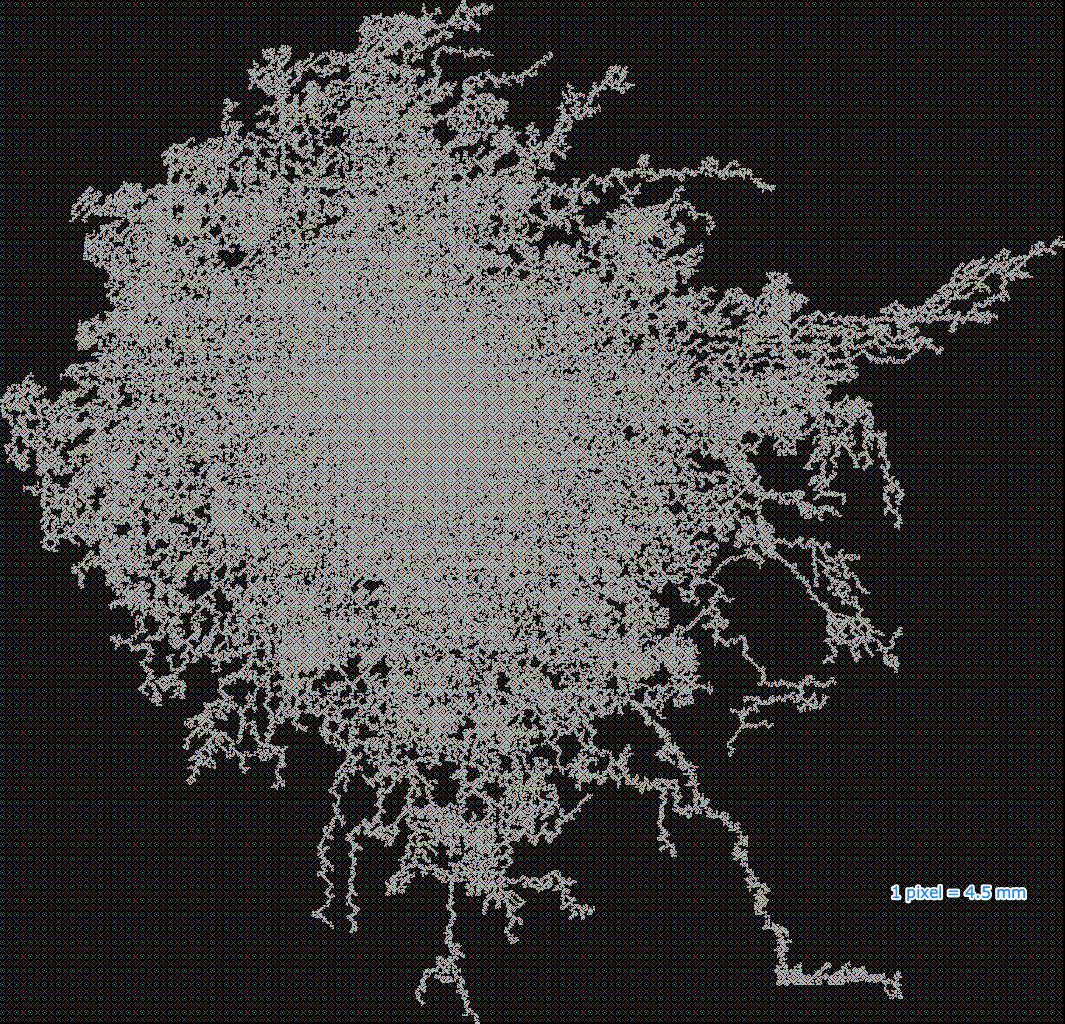
In November 2011, DoctorPeaks posted to Twitter a link to this zoomed-out version of the WordSquared map:

Another WordSquared map courtesy of DoctorPeaks, capture on November 23, 2013, about one week before WordSquared shut down.
I made a chart of the tile count of the entire board as a function of time, based on numbers from the official WordSquared Twitter account and blog:

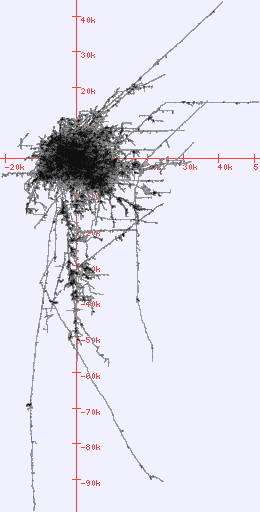
A zoomed-out plot showing the last known tile count for the WordSquared world:

The 42.2 million tiles played in Word^2 as of March 10th, 2011 made 14.86 million words.

As of January 26, 2012, 63 million words had been played, corresponding to 141 million tiles. (If the tiles-to-words ratio had held at 2.8 tiles per new word, it would have corresponded to 179 million tiles. Instead it fell to 2.2 tiles/(new word). It may make sense for this number to decrease as the number of words increase and word chains lengthen, as there are increasingly more places that people can easily build short words. I'll have to think about this.)

The last tally I am aware of was shortly before WordSquared was closed for good. As of about November 22, 2013, 1,543,257 players had played 264,768,058 tiles, forming 123,148,431 words (2.15 tiles/(new word)).

Outdated questions:

What is the deal with the new version of WordSquared?

It's live! Here is my review.

You can still sign up to be a beta tester for new features by clicking here.

Blanks don't work. What's the deal?

This question is now kind of irrelevant since blanks now have to be bought.
There is a bug that is affecting older browsers. A browser that supports HTML5 fully should allow you to use blanks. Otherwise, just swap tiles when you get too many blanks.


I lost my game in the switchover from scrabb.ly to wordsquared.com. What do I do?

First, visit http://scrabb.ly. Your browser should then forward you back to wordsquared.com, but with your scrabb.ly cookies duplicated over to restore your game. If your score and username and tiles show up in WordSquared, but you can't find the words that you made, try clicking on the new home button in the upper left hand corner of the minimap:


That should take you back to the last word you made. If that doesn't work, try reading about tracking locations.


How do I end the game so I can start over in a new spot?

Since the teleportation feature means you can never really get stuck, your game never ends. You can just pick up and move to a different spot.
Either delete your wordsquared.com cookies or log out.


How can I keep track of locations on the WordSquared map?

Old answer (retained for backward compatibility with old posts):
If you look through the cookies that your web browser has stored (generally buried in the web browser preferences, under some heading like "Privacy" or "Security"), you will find a few cookies set by wordsquared.com. One is called "grid_origin" (it was called "gridOrigin" in previous versions). It looks something like this: [wordsquared.com browser cookies] The two numbers (separated by "%2C") are coordinates in columns and then rows. A grid_origin of 1992%2C-1202 should be read as (1992,-1202) and means that WordSquared is currently set to look at a position 1992 columns to the right and 1202 rows up from some reference point. (The reference point (0,0) is an area where the tiles are very dense and is almost certainly where the first WordSquared word was played.)

If you open up WordSquared in your browser, drag the map to a new position, and then recheck the cookies, you will find that the grid_origin value has changed. (Note that you now have to drag the map instead of the board in order to update the grid_origin cookie. Dragging just the board will update the worldOffset cookie. It may be a better reference, but those numbers are horribly long!)

If you lost your position in the switchover from scrabb.ly to wordsquared.com, you can just look at your grid_origin cookie for scrabb.ly and then drag the board in wordsquared.com until you get the WordSquared grid_origin cookie close to matching the scrabb.ly grid_origin coordinates. Then (like magic!) you will be back where you were when last playing Scrabb.ly.


If you want more official answers to your questions, you can get in touch with the WordSquared team, either through their customer service site or their Twitter account or by mailing support at [the name of the site for the game]. WordSquared now also has a blog!

[Last updated,February 2014]


Further reading:

Friday, October 22, 2010

Advanced Scrabb.ly/WordSquared techniques

I recently posted an introduction to Scrabb.ly (now called WordSquared). Since then, I have still been playing, loading up Scrabb.ly from time to time and extending my original chain of words. Here are a few survival tips that I have learned:

When you see other players encroaching, run away! It's pretty easy to just keep forming words on a grid with open space. You can generally find some place in your grid to fit nearly any letter, and in the worst case, you can hit "swap tiles" and start off with a new set of letters. The biggest threat to your survival is being boxed in by other players (but see below about how to deal with that).

Start in a relatively empty part of the board. New players will be randomly placed near recent activity, but you don't really want to be within sight of another player. They might perceive you as a threat and try to box you in. It's better to backtrack from the front a little and find a quiet place where you can start building on your own. That way you can get your bearings and build up a big enough grid that you can always find some place to dump letters.

To be sure that your part of the board is open, keep in mind that...
The map is not the territory. Currently, the little map up in the left hand corner (which can be expanded by clicking on the box with the arrows in it) is not up to date. It seems like it is updated maybe once a day (if that). Note that this is likely to change in the future, as the site is improved. For now, it means that if you want to scope out the competition, you have to drag around the board (which can also be done by dragging on the map) to see where the tiles actually are.... [OK, the map updates more quickly now, at least for a player's own tiles which appear in a chunkier white trail dynamically added as another layer over the main map]. In addition to checking out the big version of the map from time to time, it also helps to keep an eye on the little expanding circles that appear on the map whenever someone plays a word.

It is possible to break out when surrounded! This technique was written up by SPAZIN who is currently third on the leaderboard (for human players). He explained his technique here. (You can tell he is an expert from how concisely he explains it). I thought it would benefit from a bit more description, so I decided to expand on it a little below.

Step 1: Identify a place to break through:

Here I decided that I could build to the left through another player's DEN to make a word like INDENT.

Step 2: Build over in that direction.


Step 3: Plan your approach.

At this point I was close enough to map out a specific path. I imagined hanging an O off of the S to make SO, and then constructing a three-letter word like AGO from that O, and finally a three-letter word like SEA, where the S would form the end of the eventual word INDENTS.


I then had to go off to some other part of my grid to dump a lot of letters before I got the tiles I needed to make INDENTS.

Step 4: Break out.
Before:

After:
Note that the DEN tiles now have dark letters, indicating that I now have a partial claim to them. I believe this means that I could build off of any of them, even if none of my original tiles are involved.

Step 5: Run away!

You can now escape the blockade and continuing playing Scrabb.ly as usual.

Have fun!


Further reading:

Saturday, October 16, 2010

Scrabb.ly/WordSquared - Massively Multiplayer Online Word-formation Game

The biggest word game ever is slowly growing still bigger over at Scrabb.ly (recently renamed "WordSquared"). Created by four programmers over 48 hours for a competition, it's effectively an infinite grid (though currently limited to a giant square with each side being about 200 million tiles long) on which people all over the Internet are simultaneously laying down tiles to build words. You can play it in most recent web browsers at http://wordsquared.com.


For your first move, you can build a word (using a subset of your seven available tiles) off of any available tile on the board. For all subsequent moves, you need to build off of your own words.

Scoring is like in Scrabble. The tiles have values on them, and the grid has been formed by putting a bunch of Scrabble boards together, overlapping the rows and columns on the edges, so that the triple word score squares are shared with the neighboring boards.

Additionally, you have a certain number of available "lives" like in a video game. If you swap out your rack for new letters, you lose a life. If you form a word that overlaps one of those bonus squares in the center (the ones with the star on them), you gain a new life.

Probably my favorite part about this game is exploring the map of the grid. A lot of the overall structure of the interlocking words looks rather organic, but there are a few places on the grid where someone (possibly automated scripts) have constructed long staircases of two-letter words or other regular structures.


One downside is that the site is a bit slow to load, and even just when I switch over to the browser tab that has Scrabb.ly in it, the browser hangs for a while. Every time you enter a word, the game takes several seconds to update and give you your new letters. [This is no longer an issue, as the updated version of the game is much faster.] Also, the large scale map seems to be updated very infrequently (maybe every few hours or once a day), so by exploring the apparent frontier (by switching back from the map view to the zoomed-in grid view), you will find that there may be words several board lengths beyond where the map suggests they will be.

If you stop playing and come back later, your previous position on the map and tiles should be restored, assuming you are using the same web browser... Player identification is done through cookies. "Claiming" your words by adding a username (or Twitter username (preceded by the "@" symbol)), just makes public your position on the high scores list... it does not enable you to set a password or log in from another computer or browser. I would guess that this will be changed in Scrabb.ly 2.0. If you are lost on the board, you can find your words by clicking on them in the word history bar on the right hand side.

The game is still a bit buggy. If it gets confused about what tiles you have or anything else, you can always reload the page in your browser. And I have found that the blanks can never be used to form words in all but the most recent browser versions. If I try to use them, I get prompted to enter what letter they represent, but then the word never gets accepted. There were reports that blanks would be accepted if used as the final letter in a word, but that's not working for me either. Basically, I save up blanks until my rack becomes unusable and then hit the "Swap Tiles" button.

One other caution about this game: It can be kind of addictive.

If you want a lot more Scrabb.ly information, you can watch this YouTube video of one of the Scrabb.ly programmers giving a talk about the game. There are some fairly technical details between about minutes 5 and 10, but most of the rest of the talk is pretty accessible.

The designers have apparently considered making a similar gigantic chess or checkers game (with appropriate rule modifications) or giving some classic 8-bit Atari games the Scrabb.ly treatment. A planned Scrabb.ly 2.0 will have some social features and additional new game mechanics. They might also incorporate play in foreign languages, but still on the same grid as the original game, though possibly starting each language in a different sector of the board, just for the fun of watching what would happen when two language grids collide.


Further reading: